
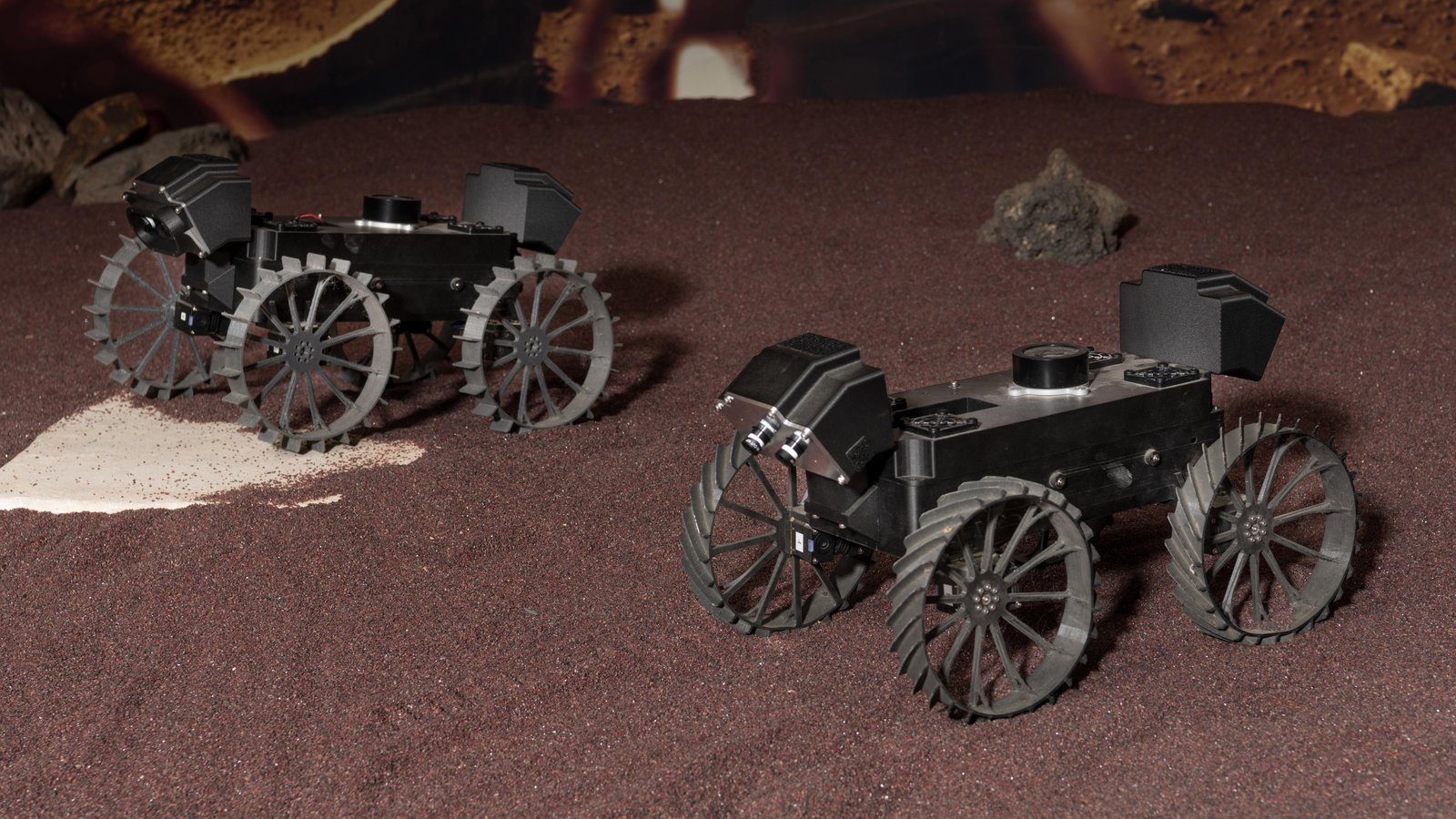
How fleets of cooperative robots could prepare habitats, mine resources, and scout terrain before crewed missions.
The surface of Mars presents an unforgiving challenge to human explorers: toxic dust, extreme temperature swings, intense radiation, and a thin carbon dioxide atmosphere. Before astronauts can safely land and establish a foothold, significant infrastructure must be in place—habitats constructed, resources extracted, and hazards identified. This is where robotic swarms emerge as a revolutionary solution, capable of transforming Mars from a barren wasteland into a prepared outpost for humanity.
The Swarm Advantage: Many Hands Make Light Work
Unlike traditional single-robot missions like Curiosity or Perseverance, robotic swarms operate on principles borrowed from nature—think ant colonies, bee hives, or flocks of birds. Individual robots may be simple and specialized, but together they exhibit complex, coordinated behaviors that far exceed the sum of their parts.
The advantages are compelling:
- Redundancy and Resilience: If one robot fails, the mission continues. Traditional single-robot missions represent a single point of failure—lose the rover, lose the entire mission. With swarms, individual losses are merely setbacks.
- Distributed Processing: Tasks can be parallelized across dozens or hundreds of units, dramatically accelerating operations like terrain mapping, sample collection, or construction.
- Scalability: Swarms can grow or shrink based on mission needs. Deploy more units for ambitious projects or scale back during dormant periods.
- Adaptive Behavior: Swarm algorithms allow robots to respond dynamically to changing conditions without constant human oversight, essential given communication delays of 4 to 24 minutes between Earth and Mars.
Mission One: Habitat Construction
The first critical task for robotic swarms is preparing shelter. Human astronauts cannot survive Mars’s hostile environment in simple tents or landers. They need robust, radiation-shielded habitats, ideally constructed using in-situ resources to minimize cargo from Earth.
The Construction Process
Site Selection: Scout robots equipped with ground-penetrating radar and spectrometers identify ideal locations—near water ice deposits, on stable terrain, with access to sunlight for solar power. Swarms can survey vast areas simultaneously, creating detailed 3D maps that would take a single rover months to compile.
Material Processing: Excavator robots dig Martian regolith, while processor units sinter or bind the soil using microwave heating or chemical additives. NASA has already tested technologies like contour crafting and sintering processes that fuse regolith into brick-like materials using solar concentrators or microwaves.
Assembly: Builder robots, coordinating through distributed algorithms, layer these materials into dome or cylinder structures. Some designs envision inflatable modules covered with regolith for radiation protection, requiring swarms to excavate, transport, and precisely deposit protective layers.
The beauty of this approach lies in its autonomy. While engineers on Earth can adjust parameters and goals, the swarm operates semi-independently, adapting to unexpected obstacles—shifting soil, equipment failures, or dust storms—without waiting for instructions across interplanetary distances.
Mission Two: Resource Extraction
Mars is resource-poor compared to Earth, but it’s not barren. Water ice lurks beneath the surface, carbon dioxide fills the atmosphere, and minerals pepper the regolith. Robotic swarms can extract and process these materials to support human life and fuel return journeys.
Water: The Foundation of Survival
Water is essential—for drinking, growing food, generating oxygen, and producing rocket fuel. Mars has abundant water ice at the poles and scattered deposits in mid-latitudes, buried beneath protective dust layers.
Mining swarms would work in coordinated teams: excavators dig trenches or bore holes, thermal extraction units heat the soil to release water vapor, and collectors condense and store the precious liquid. Imagine dozens of small rovers working a grid pattern, systematically extracting ice from hectares of terrain, feeding central processing stations that electrolyze water into hydrogen and oxygen—breathable air and rocket propellant in one elegant process.
Atmospheric Processing
Mars’s atmosphere, though thin, is 95% carbon dioxide. Robotic processors can convert CO₂ into oxygen via solid oxide electrolysis or the Sabatier reaction, which combines CO₂ with hydrogen to produce methane fuel and water. NASA’s MOXIE experiment aboard Perseverance has already demonstrated oxygen production on Mars—scaling this up with autonomous robot-tended facilities is the logical next step.
Mineral Extraction
Beyond water and air, swarms can mine metals and minerals for construction, spare parts, or manufacturing. Iron oxide gives Mars its red color, and robotic refineries could extract pure metals for 3D printing tools, habitat components, or repair materials. This reduces dependence on supply missions from Earth, making long-term Mars habitation economically viable.
Mission Three: Terrain Scouting and Hazard Identification
Mars holds many unknowns. Ancient lava tubes might offer natural shelters or harbor geological surprises. Boulder fields could hide valuable minerals or obstruct landing zones. Dust storms, though less violent than Hollywood portrays, still pose risks to solar panels and machinery.
Robotic swarms excel at reconnaissance:
- Geological Surveys: Small, mobile robots equipped with cameras, spectrometers, and seismometers fan out across regions, creating high-resolution maps of surface composition, subsurface structures, and potential hazards like unstable slopes or hidden ice deposits.
- Weather Monitoring: Distributed sensor networks track dust storms, temperature fluctuations, and radiation levels in real-time, providing data crucial for planning human activities and protecting equipment.
- Pathfinding: Before humans traverse unfamiliar terrain, swarms can test routes, identify safe corridors, and flag obstacles. They can even pre-position supply caches or communication relays along planned exploration routes.
In essence, swarms transform Mars from an alien mystery into a well-documented environment, reducing risks for incoming crews and maximizing the efficiency of their limited surface time.
The Technology Behind Swarm Intelligence
How do dozens or hundreds of robots coordinate without direct human control? The answer lies in swarm intelligence algorithms, inspired by natural systems.
Decentralized Decision-Making
Unlike hierarchical systems where a central controller directs every action, swarm robots follow simple, local rules. Each robot senses its immediate environment and communicates with nearby neighbors. From these interactions, complex global behaviors emerge organically.
For example, in construction tasks, robots might follow rules like: ‘Move material from source to destination,’ ‘Avoid collisions with neighbors,’ and ‘Fill gaps in the structure first.’ No single robot understands the full blueprint, yet collectively they build coherent structures.
Communication Protocols
Swarm robots communicate via short-range wireless networks, sharing data about obstacles, task progress, or equipment status. Advanced swarms use mesh networks where each robot acts as a relay node, extending communication range across large areas. If one robot moves out of range, others adjust routes to maintain connectivity.
Machine Learning and Adaptation
Modern swarm systems incorporate machine learning, allowing robots to improve performance over time. They learn which terrain types are easiest to navigate, optimize energy consumption patterns, or identify anomalies faster through experience. This adaptability is crucial on Mars, where conditions differ vastly from Earth-based simulations.
Challenges and Solutions
Deploying robotic swarms on Mars is not without obstacles:
Power Constraints
Mars receives less than half the sunlight Earth does, and dust can obscure solar panels. Swarms need efficient energy management—harvesting solar power during the day, conserving energy at night, and perhaps sharing power wirelessly between units. Nuclear radioisotope thermoelectric generators (RTGs), while expensive, could power critical swarm nodes, ensuring continuous operation.
Dust and Wear
Martian dust is fine, abrasive, and electrostatically charged—it clings to everything. Robots need robust sealing, self-cleaning mechanisms, and durable components. Swarm redundancy helps here: if dust disables a few units, the rest continue working. Design for replaceability allows functional robots to cannibalize failed units for spare parts.
Communication Delays
Earth-Mars communication lags range from 4 to 24 minutes one-way. Swarms cannot rely on real-time human oversight. Instead, they operate under goal-oriented autonomy: humans set high-level objectives (‘build a habitat at these coordinates’), and the swarm figures out the details. Periodic check-ins allow course corrections, but day-to-day decisions rest with the robots.
Reliability and Repair
Robots will fail. The key is designing systems that degrade gracefully. Swarms with built-in repair capabilities—where certain units act as mobile technicians—can extend mission lifespans significantly. Modular designs enable quick component swaps, and 3D printing facilities operated by the swarm itself could fabricate replacement parts on demand.
Real-World Progress and Prototypes
Several projects and experiments are already paving the way:
- NASA’s Swarmathon: This competition challenges students to develop swarm robotics systems for space exploration, testing algorithms in Mars-analog environments.
- ESA’s Autonomous Rover Swarms: The European Space Agency is researching cooperative rover systems for lunar and Martian missions, focusing on collective mapping and resource identification.
- MIT’s Autonomous Construction Robots: Researchers are developing robots capable of building structures collaboratively, using algorithms adapted from termite mound construction behaviors.
- RASSOR Excavator: NASA’s Regolith Advanced Surface Systems Operations Robot demonstrates autonomous digging and material transport—key capabilities for swarm-based resource extraction.
These projects showcase incremental progress toward fully operational Martian swarms, refining hardware durability, software intelligence, and operational strategies through rigorous testing.
The Timeline: When Will Swarms Reach Mars?
Realistic deployment likely aligns with broader Mars exploration timelines. If NASA’s Artemis program successfully returns humans to the Moon in the late 2020s, lessons learned could accelerate Mars preparations. A plausible scenario:
- Early 2030s: Initial small-scale swarm demonstrations—perhaps 5 to 10 robots—deployed alongside traditional rovers, testing coordination and autonomous operations.
- Mid-2030s: Larger swarms of 20 to 50 units arrive on cargo missions, beginning habitat site preparation and resource extraction at targeted landing zones.
- Late 2030s to Early 2040s: Mature swarm infrastructure operational before the first crewed missions, with habitats partially constructed, water ice stockpiled, and oxygen production facilities running autonomously.
This phased approach minimizes risks, allowing iterative improvements and troubleshooting before human lives depend on swarm-built infrastructure.
The Human-Robot Partnership
It’s tempting to view robots as replacements for humans, but the truth is more nuanced. Swarms handle the dangerous, repetitive, and time-consuming work—excavation, construction, monitoring—that would burden astronauts or expose them to unnecessary risks. Humans bring creativity, adaptability, and problem-solving skills that no algorithm can yet match.
Picture this: Astronauts arrive on Mars to find a habitat already assembled, life support systems operational, and stockpiles of water and oxygen waiting. Instead of spending months building shelter and mining resources, they focus on scientific discovery, geological exploration, and expanding human presence. The swarm continues working in the background, extending infrastructure, scouting new sites, and supporting human operations.
This partnership multiplies what humans can achieve. Swarms prepare the ground; humans push the frontiers.
Beyond Mars: Swarms in the Solar System
The principles guiding Martian swarms apply throughout the solar system. On the Moon, robotic crews could build outposts in permanently shadowed craters near ice deposits. On asteroids, swarms might extract rare metals or establish fuel depots for deep-space missions. Even Europa or Enceladus—moons of Jupiter and Saturn with subsurface oceans—could host autonomous explorers, drilling through ice shells and navigating alien seas.
Each environment presents unique challenges, but swarm adaptability makes them ideal for diverse missions. Their decentralized nature ensures resilience in the face of unknowns, whether navigating asteroid boulder fields or investigating geysers on icy moons.
Conclusion: The Silent Vanguard
Robotic swarms represent a quiet revolution in space exploration. They won’t generate the headlines that crewed missions do, but their contributions will be foundational. By preparing habitats, extracting resources, and mapping terrain, they transform Mars from an inhospitable frontier into a welcoming destination.
As we stand on the threshold of becoming a multiplanetary species, swarms embody the pragmatic ingenuity required to succeed. They work tirelessly in dust storms and freezing nights, coordinating silently across vast distances, building the infrastructure that will shelter future generations of explorers.
In the grand narrative of Mars exploration, swarms are the unsung heroes—the silent vanguard that makes the impossible possible, one autonomous robot at a time.
ImageCredit: NASA’s CADRE