
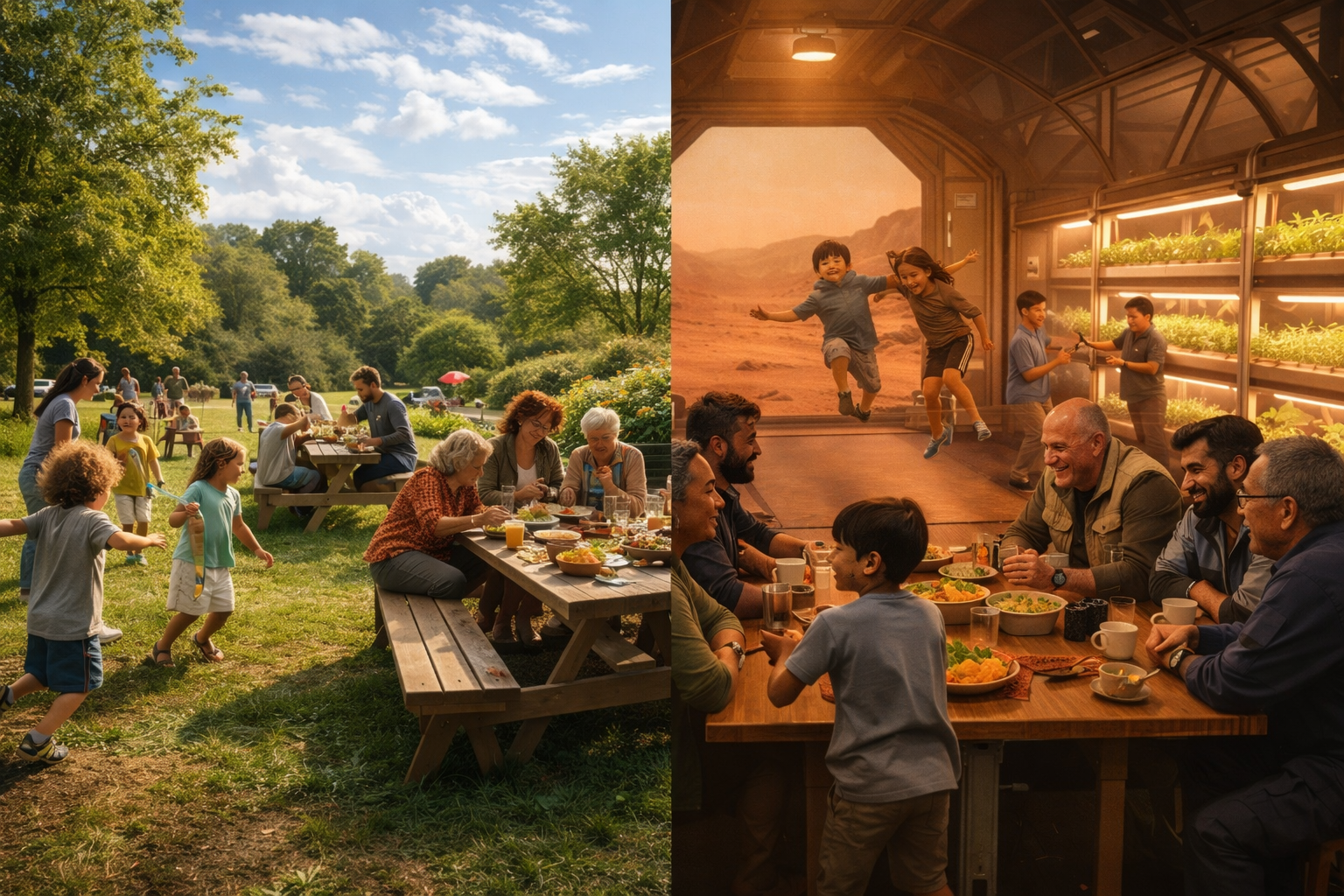
Philosophical and sociological reflections on how isolation and distance reshape culture
When humans first set foot on Mars, they will carry with them the accumulated culture of millennia, languages, traditions, values, and identities forged on Earth. But what happens when a community becomes separated from its planetary home by millions of kilometers and minutes of communication delay? History suggests that isolation doesn’t merely preserve culture; it transforms it. Mars may not just be humanity’s next frontier—it could be the birthplace of our first truly extraterrestrial culture.
The Laboratory of Isolation
Human history offers compelling precedents for understanding cultural divergence. When Polynesians settled remote Pacific islands, when Europeans colonized the Americas, when communities became isolated by geography or circumstance, culture didn’t remain static. It adapted, evolved, and sometimes transformed entirely. The Pitcairn Islanders, the Icelandic settlers, the Australian colonists—each developed distinct cultural identities shaped by their unique environments and separation from their origins.
Mars presents an extreme version of this dynamic. The physical distance isn’t measured in ocean crossings but in astronomical units. Communication with Earth involves delays ranging from 4 to 24 minutes each way, making real-time conversation impossible. Supply chains operate on two-year cycles aligned with planetary orbits. Perhaps most significantly, the Martian environment itself,the rust-red landscapes, the thin atmosphere, the altered gravity, will form a backdrop utterly unlike anything humanity has known.
This isolation isn’t merely physical. It’s temporal, experiential, and ultimately psychological. Martian settlers will face challenges that Earth-dwellers can understand intellectually but never viscerally. The first child born on Mars will be the first human whose entire physical existence has been shaped by Martian gravity. What does “home” mean to someone who has never breathed Earth’s air?
Identity in a New World
Identity formation occurs at the intersection of individual experience and collective narrative. On Earth, our identities are woven from threads of nationality, ethnicity, religion, and countless other affiliations. We are shaped by the weight of history and the presence of diverse Others. On Mars, these familiar markers of identity may blur, transform, or even dissolve.
Consider the concept of nationality. The first Mars settlements will likely be international collaborations, mixing crew members from multiple nations and cultures. When you’re living in a pressurized habitat where survival depends on collective cooperation, does it matter whether your colleague was born in Beijing, Berlin, or Bangalore? The shared identity of “Martian” may quickly supersede Earth-based national affiliations.
Yet this raises profound questions: Will Mars simply become a melting pot where Earth identities fade, replaced by a monolithic “Martian” culture? Or might the isolation and small population size paradoxically intensify certain cultural elements while allowing others to atrophy? Sociologists note that small, isolated communities often develop strong in-group cohesion but may also experience intense interpersonal conflicts. The social dynamics of a Mars base might resemble those of Antarctic research stations, submarine crews, or remote island communities, intensified by the impossibility of leaving.
Language: The First Frontier of Divergence
Linguists have long observed that language evolves most rapidly when populations become isolated. From the divergence of Latin into the Romance languages to the development of distinct English dialects in America, Australia, and beyond, separation breeds linguistic innovation.
On Mars, several factors will accelerate this process. The technical vocabulary of Martian life, terms for equipment, procedures, environmental conditions, will inevitably develop local color and efficiency. Why say “atmospheric pressure maintenance system” when “presser” or “atmo-lock” will do? Slang will emerge from shared experiences unique to Mars: the particular quality of Martian light, the sensation of reduced gravity, the psychological states associated with dust storms or Earth-rise.
Communication delays with Earth may also foster linguistic independence. Real-time language policing from Earth-based authorities becomes impossible when every exchange requires extended waiting periods. Young Martians, particularly, may develop verbal shortcuts, inside jokes, and expression patterns that seem alien to Earth ears. Within a few generations, Martian English (or Mandarin, or Hindi) could diverge significantly from its terrestrial parent.
More intriguingly, the experience of living on Mars may necessitate new words for new concepts. How do you describe the feeling of seeing Earth as a pale blue dot in the Martian sky? What word captures the unique psychological state of knowing you can never spontaneously return to the planet where your species evolved? Language shapes thought, and Martian experience may demand linguistic tools that Earth languages have never needed.
Values Under Pressure
Every culture embodies a value system, often implicit, about what matters, what’s good, what deserves protection and celebration. On Mars, these values will face extraordinary pressure.
Collectivism vs. Individualism: Earth cultures span a spectrum from highly individualistic to deeply collectivist. Mars settlements, at least initially, will require unprecedented levels of cooperation and mutual dependence. A single person’s mistake could threaten everyone’s survival. This reality may push Martian culture toward collectivist values regardless of settlers’ Earth origins. The individual freedom to “do your own thing” becomes a luxury when everyone’s breathing the same recycled air.
Yet humans are complex. History also shows that isolated communities sometimes produce fierce individualists precisely because everyone knows everyone else’s business. The tension between necessary cooperation and the human need for autonomy and privacy will likely define much of Martian social life.
Relationship with Nature: On Earth, we increasingly speak of environmental conservation and humanity’s place within ecosystems. On Mars, the equation inverts. Mars has no biosphere to preserve, settlers will create livable environments. The Martian relationship with nature becomes one of engineering rather than stewardship. Does this make Martians more or less likely to value environmental ethics? Will they see themselves as life’s ambassadors to a dead world, or as conquerors of an alien frontier?
Attitudes Toward Risk: Earth cultures vary in their risk tolerance, but Mars settlements will attract individuals comfortable with extraordinary risks. Over generations, this selection pressure, combined with the daily reality of living in an unforgiving environment, may produce a culture with distinctive attitudes toward danger, innovation, and safety. Children raised on Mars might develop a matter-of-fact acceptance of environmental hazards that would seem reckless to Earth-dwellers.
The Mythology of Mars
Cultures are built not just on values and language but on stories, creation myths, founding narratives, heroes and villains. Mars will develop its own mythology, and we can already glimpse its outlines.
The story of the first footsteps on Mars will be Mars’s equivalent of the Apollo 11 landing, but intensified by the permanence of settlement. Unlike the Moon landings, where astronauts visited briefly, Mars settlement implies staying, surviving, and ultimately thriving. The pioneers who first made Mars livable will likely occupy a place in Martian culture analogous to the Founding Fathers in American mythology or the First Fleet in Australian history.
But myths serve social functions beyond commemoration. They justify present realities and guide future action. What myths will Martians tell themselves about why they’re there? Are they refugees from a dying Earth, pioneers of a new frontier, or the vanguard of humanity’s cosmic destiny? Each narrative implies different values and priorities.
Consider too the mythology around Earth itself. To Martians, Earth may become a mythical place, the world of plenty, the green paradise lost, the Old World whose problems Mars has transcended. This mythologizing could go either direction: Earth as Eden or as cautionary tale. The stories Martians tell about Earth will reveal much about their own self-conception.
The Question of Freedom
Political philosophy has long grappled with the relationship between freedom and necessity. Mars presents this tension in stark relief. In the early stages of settlement, survival necessitates strict protocols, technical expertise, and coordinated action. There’s no room for libertarian experiments when the air itself is manufactured.
Yet humans chafe under authority, especially when isolated from the traditional sources of legitimacy. The history of remote settlements, from colonial outposts to research stations, shows that authority becomes contested when you can’t easily send in reinforcements. Mars settlements may develop their own forms of governance, potentially quite different from Earth models.
Will Mars become a testbed for new political systems? The delays in communication with Earth mean Martian communities must be largely self-governing. They might experiment with direct democracy (feasible in small populations), technocracy (rule by technical experts), or entirely novel systems shaped by Martian realities.
The question of independence, political, cultural, psychological, looms large. At what point does a Martian settlement stop being an outpost of Earth civilization and become something else? When do Martians stop seeing themselves as Earthlings living on Mars and start being simply Martian?
Children of Mars
Perhaps no question cuts deeper to the heart of Martian identity than that of the first generation born there. These individuals will be, in a profound sense, alien, adapted to Martian gravity, shaped by Martian experiences, inheritors of a culture diverging from Earth’s.
Developmental psychology emphasizes the importance of early experiences in shaping identity. Martian children will have radically different formative experiences than their Earth-born peers. They’ll learn to walk in lower gravity. Their concept of “outside” will mean a lethal environment requiring protective equipment. They may never experience rain, ocean waves, or the sensation of wind on unprotected skin.
How will this shape their psychology? Their values? Their sense of possibility and limitation? Earth-born settlers will always carry memories of Earth, an embodied connection to humanity’s home world. But second and third-generation Martians will know Earth only through stories and video feeds, a place as mythical to them as Atlantis is to us.
This generational divide may become the most significant fault line in Martian culture. Earth-born settlers might cling to Earth traditions and identities, seeing themselves as perpetual exiles. Mars-born generations might find these attachments puzzling or even constraining. “Okay, boomer” may take on new resonance when it means “someone who still thinks like an Earthling.”
Cultural Evolution, Not Replacement
It’s important to recognize that Martian culture won’t simply replace Earth culture, at least not initially. For the foreseeable future, the two will exist in dialogue. Earth will remain the demographic giant, the source of supplies and new settlers, the cultural center of gravity. Mars will be simultaneously dependent on and increasingly divergent from its parent civilization.
This creates a unique dynamic. Unlike historical examples of cultural divergence, where isolated populations had little contact with their origins, Mars and Earth will maintain constant (if delayed) communication. Martians will watch Earth media, follow Earth news, maintain relationships with Earth-dwellers. This connectedness may slow cultural divergence, or it may intensify it by constantly highlighting differences.
Social media and internet culture on Earth show how online communities can develop distinct identities while remaining connected to broader society. Martian culture might evolve similarly: sharing the same basic linguistic and cultural tools as Earth but developing distinctive patterns, values, and sensibilities.
The Adaptive Advantage
From an evolutionary perspective, cultural diversity is advantageous. Different cultures represent different experiments in human living, different solutions to the eternal questions of how to organize society, raise children, find meaning, and face death. Mars offers humanity the opportunity to run a grand cultural experiment.
If Earth faces existential challenges, climate change, pandemics, political upheaval,Mars provides a backup not just for human genes but for human culture. Conversely, if Mars settlers develop solutions to problems of resource scarcity, environmental management, or social cohesion, these insights might benefit Earth.
But the value isn’t purely instrumental. Cultural diversity enriches human experience. The existence of a genuinely Martian perspective on existence, a way of being human that has never existed before, would be inherently valuable. It would expand what it means to be human.
Reflections on Unity and Diversity
This exploration of Martian cultural evolution raises uncomfortable questions about human unity. For much of recent history, we’ve moved toward increasing global integration, economically, culturally, politically. The idea of a single human family sharing a common home has enormous moral and practical appeal.
Mars complicates this narrative. It suggests that humanity’s future might be one of increasing diversity rather than convergence. We might become a species of multiple cultures, adapted to different worlds, with increasingly divergent values and identities. This isn’t necessarily bad, diversity has its own value, but it challenges assumptions about human unity.
Yet perhaps the lesson is more subtle. Mars may redefine what human identity means, but it doesn’t erase our common heritage. All Martians, no matter how culturally distinct they become, will share a history and biology that originated on Earth. They’ll read Shakespeare and Rumi, celebrate ancestral festivals, and trace their lineage to a small blue planet. The question isn’t whether Martians will be human, they will be, but rather what new ways of being human they’ll discover.
The Mirror of Mars
Ultimately, thinking about Martian cultural evolution forces us to examine assumptions about culture and identity we rarely question. What aspects of human culture are truly universal, grounded in our biology and psychology? What aspects are contingent on Earth’s environment and history? Which of our values reflect timeless truths about human flourishing, and which are merely adaptations to terrestrial circumstances?
Mars holds up a mirror to humanity. In imagining how isolation and distance might reshape culture, we’re really asking: What is essential about being human? What can change without us losing ourselves? How much diversity can humanity encompass while remaining recognizably human?
These questions have no final answers. They’ll be answered not through philosophy alone but through the lived experience of generations of Martians. The culture that emerges on Mars will be one of humanity’s grand experiments, a new way of being human, forged in the isolation and grandeur of another world.
And perhaps, in the end, the most important insight is this: culture isn’t fixed or eternal. It’s adaptive, creative, and endlessly generative. Humans don’t just inherit culture; we make it, remake it, and transform it in response to our circumstances. Mars won’t just host human culture, it will transform it, producing something new while remaining connected to the deep wellsprings of human creativity and meaning-making that have characterized our species from its origins.
The Martians of the future may look up at the blue dot of Earth in their sky and feel a connection to ancestors they never met, speaking languages they hardly recognize, living in ways they can barely imagine. And that connection, tenuous, transformed, but genuine, may be what ultimately defines human identity across the cosmos. Not sameness, but shared origin. Not unity, but kinship. Not a single culture, but a family of cultures, all bearing the spark of humanity to new worlds.
What aspects of culture do you think would change most rapidly on Mars? Join the conversation in the comments below.