
How microgravity bioprinters could revolutionize organ transplantation and long-duration crew health
The Crisis on Earth, The Solution in Space
Over 103,000 people in the United States alone currently wait for lifesaving organ transplants. Every day, approximately 17 people die before a matching organ becomes available. Despite advances in surgical
techniques and immunosuppressive therapies, the fundamental challenge remains: there simply aren’t enough donor organs to meet demand.
Meanwhile, 400 kilometers above Earth’s surface, a quiet revolution is taking place aboard the International Space Station. Scientists are successfully printing human tissue in conditions impossible to replicate on our
planet, opening a pathway that could eventually solve the organ shortage crisis while simultaneously enabling humanity’s expansion into the cosmos.
Why Microgravity Changes Everything
On Earth, bioprinting faces a fundamental physical constraint: gravity. When scientists attempt to print soft
tissues using cell-laden bioinks, the structures often collapse under their own weight before cells can establish the connections necessary for structural integrity. To compensate, researchers must add scaffolding materials, thickening agents, or high-viscosity compounds to maintain shape during the printing and maturation process.
These workarounds create their own problems. Scaffold materials can interfere with cell-to-cell communication, impede nutrient flow, and sometimes trigger immune responses. They also limit the complexity of structures that can be created, particularly for delicate tissues like cardiac muscle or vascular networks.
In the near-weightlessness of low Earth orbit, these constraints vanish. Soft bioinks maintain their three- dimensional structure without external support, suspended in space during printing. Cells can be arranged with precision, layer upon layer, without the mechanical stress that would cause terrestrial prints to deform or fail.
As one bioprinting researcher explained, this represents a paradigm shift: “We can print biology only for the sake of biology, not the sake of mechanics.”
From Concept to Reality: Bioprinting on the ISS
The theoretical promise of microgravity bioprinting has begun to yield tangible results. Multiple organizations have successfully deployed bioprinting systems to the ISS, each advancing our understanding of what’s possible beyond Earth’s gravitational pull.
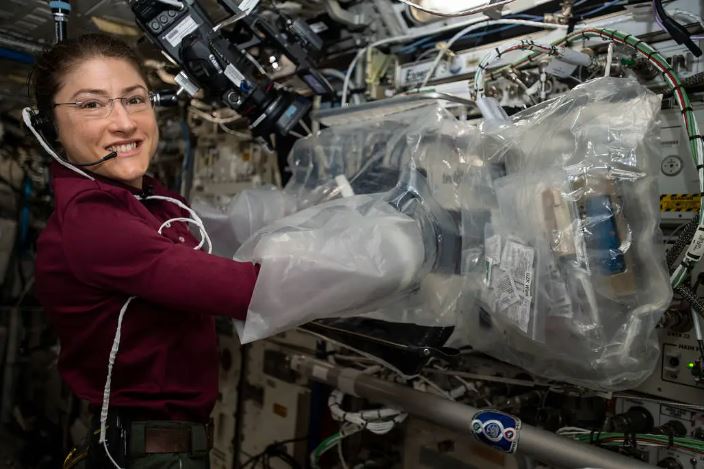
The BioFabrication Facility
Developed by Redwire Corporation (formerly Techshot) in partnership with nScrypt, the BioFabrication Facility
(BFF) achieved a significant milestone in September 2023: the first successful bioprinting of a human knee meniscus in orbit. The meniscus, a critical component of the musculoskeletal system and one of the most commonly injured tissues among military personnel and athletes, proved to be an ideal testbed for orbital biofabrication.
The experiment utilized mesenchymal stem cells suspended in a collagen-based hydrogel bioink. After initial printing in microgravity, the tissue underwent a period of maturation in orbit before returning to Earth for analysis. The results demonstrated that complex tissue structures could be fabricated in space using
formulations that would be impossible to work with under normal gravity.
The BFF’s capabilities extend beyond meniscus tissue. In November 2023, Redwire launched materials to bioprint cardiac tissue aboard the ISS. The facility, roughly three feet wide and two feet tall, houses four print heads capable of precisely depositing cellular and extracellular material through dispensing tips twice the diameter of a human hair. Its linear motor systems can drive at speeds exceeding 700 millimeters per second— essential for time-sensitive bioprinting processes in microgravity.
International Efforts in Orbital Biofabrication
Russia’s space agency Roscosmos deployed the Organ.Aut platform in December 2018, utilizing magnetic levitation technology to manage tissue spheroids in microgravity. In 2019, the system achieved another first: successfully bioprinting human bone tissue fragments using a magnetic nanoparticle mixture containing living human cells and calcium phosphate ceramics.
The European Space Agency and German Aerospace Center (DLR) are developing the Bioprint FirstAid device, a handheld bioprinter designed to create customized wound dressings from a patient’s own cells. The device
addresses a critical need for long-duration missions: wound healing is impaired in microgravity, and traditional bandages may not provide optimal treatment for injuries that occur far from Earth.
LambdaVision Inc., in partnership with Space Tango Inc., has been working on protein-based artificial retinas manufactured in microgravity. The company has successfully fabricated multiple 200-layer artificial retina films in orbit, with microgravity environments providing superior stability and optical clarity compared to Earth- based production. This technology could eventually restore sight to the 30 million people worldwide suffering from degenerative retinal diseases.
The Technical Challenges of Space Biofabrication
While microgravity solves some problems, it introduces others. Every aspect of the bioprinting process—from bioink preparation to tissue maturation—must be reimagined for the space environment.
Liquid Handling in Zero-G
Microgravity fundamentally alters fluid behavior. On Earth, gravity causes bubbles to rise in bioinks, making their removal straightforward. In orbit, bubbles remain dispersed throughout the material, potentially compromising print quality. Solutions include centrifugation of bioinks, preparation of ready-to-use
formulations on Earth for shipment under controlled conditions, or incorporation of bubble traps within the bioprinter’s fluidic pathways.
Paradoxically, microgravity offers advantages in addressing cell sedimentation, a persistent problem in terrestrial bioprinting. On Earth, cells settle in bioink cartridges during printing, causing density fluctuations in printed samples. This issue disappears in orbit, where cells remain uniformly distributed.
Safety and Contamination Control
Strict safety regulations govern space operations. Many substances routinely used in cell-based research and bioprinting on Earth—including common fixatives—cannot be utilized aboard the ISS. Researchers must develop alternative protocols and bioink formulations compatible with space station safety requirements.
Any fluid leak in microgravity doesn’t simply spill downward; it spreads in all directions. This necessitates bioprinting equipment operation within closed fabrication hoods, adding complexity to system design while protecting crew and equipment.
Resource Constraints and Logistics
Delivering materials to the ISS presents unique challenges. Bioinks, cells, and culture media must maintain viability during launch and storage in the limited space available aboard the station. Current launch costs— approximately $2,000 per kilogram to low Earth orbit—make every shipment expensive, though emerging heavy-lift vehicles promise to reduce this to around $100 per kilogram.
These constraints favor development of ready-to-use bioinks prepared on Earth, extended shelf-life formulations, and autonomous or semi-autonomous printing processes that minimize crew time requirements.
Implications for Deep Space Exploration
As humanity plans missions to the Moon, Mars, and beyond, the ability to manufacture biological materials in space becomes not just beneficial but essential. A mission to Mars, lasting 30 months or more, cannot rely on resupply from Earth. Crews will need medical self-sufficiency unprecedented in spaceflight history.
Medical Autonomy for Long-Duration Missions
Consider the medical challenges of a Mars mission: a crew of perhaps six to eight people, isolated for years, facing the cumulative effects of radiation exposure, bone density loss, muscle atrophy, and microgravity- induced physiological changes. Traditional medicine relies on terrestrial supply chains and specialist consultations. Neither will be available to Martian explorers.
Bioprinting technology could provide:
Personalized tissue grafts for treating injuries, using crew members’ own cells to eliminate rejection risk
Organ-on-chip models for testing pharmaceutical responses under space conditions
Replacement tissues for addressing cumulative damage from radiation or other environmental factors
Research capabilities for studying how microgravity and radiation affect human tissue at the cellular level
Enabling Permanent Off-World Settlement
Long-term human presence beyond Earth—whether on Mars, lunar bases, or orbital colonies—will require more than the ability to treat injuries. It demands the capability to support human life across its entire span, including addressing age-related organ failure, genetic disorders, and diseases that develop over decades.
Traditional organ transplantation relies on donor availability and complex logistics for organ transport and preservation. These systems cannot function across interplanetary distances. Bioprinting offers an alternative: the ability to manufacture organs on-demand, anywhere humans establish presence.
The Path Forward: From Research to Reality
Despite remarkable progress, significant hurdles remain before space-bioprinted organs can be routinely used for transplantation.
Scientific Challenges
Printed tissues must demonstrate full functionality comparable to natural organs. Current demonstrations focus on simpler tissues like menisci or small cardiac constructs. Complex organs with multiple cell types, intricate vascular networks, and specialized architecture—like kidneys, livers, or lungs—remain beyond current capabilities.
Researchers must also better understand how extended microgravity exposure affects printed tissues. While initial printing benefits from weightlessness, tissues eventually destined for use on Earth must withstand the return to normal gravity without structural failure. This requires careful timing of maturation processes and possibly gradual reintroduction to gravitational forces.
Regulatory and Ethical Frameworks
Organs manufactured in space will require entirely new regulatory frameworks. Current medical device and transplant regulations assume Earth-based production under terrestrial conditions. Space-manufactured biological materials raise questions about quality control, sterility verification, and equivalence to traditional organs.
Ethical considerations include:
Who should have access to space-manufactured organs, given the initial high costs? How should organs produced using donor cell lines be allocated?
What informed consent processes are appropriate for novel space-based therapies?
How do we balance research imperatives with patient safety during the technology’s development?
Economic Viability
While launch costs are decreasing, space-based biomanufacturing must eventually justify its expense. The calculus includes not only production costs but the value proposition: organs available on-demand, reduced rejection rates through patient-specific fabrication, and elimination of donor organ shortages.
Some applications may achieve economic viability sooner than others. High-value tissues like artificial retinas or specialized grafts might justify space-based production even at current costs. Commodity organs like kidneys will likely require both technological advancement and significant reduction in access-to-orbit expenses.
Convergence with Artificial Intelligence
The future of space bioprinting increasingly involves autonomous systems. Artificial intelligence and machine learning can optimize bioink formulations, predict optimal printing parameters, and monitor tissue development with minimal human oversight.
AI-controlled bioprinters could operate continuously, adjusting protocols based on real-time analysis of cellular behavior. This becomes particularly valuable for long-duration missions, where crew time is precious and communication delays prevent real-time consultation with Earth-based experts.
Machine learning algorithms are already being deployed to analyze bioprinting outcomes, identifying
correlations between process parameters and tissue quality that might elude human researchers. As these systems mature, they could enable bioprinting operations far from Earth with reliability comparable to terrestrial facilities.
Beyond the ISS: Future Orbital Infrastructure
While the ISS provides invaluable research capabilities, it wasn’t designed as a manufacturing facility. Purpose- built orbital laboratories optimized for biofabrication could dramatically accelerate progress.
These facilities might include:
Dedicated microgravity zones with precise control over residual accelerations
Expanded biocontainment systems for working with diverse cell lines
Integrated cell culture infrastructure to support tissue maturation over weeks or months
Automated sample return systems for rapid delivery of manufactured tissues to Earth
Commercial space stations planned by various companies could incorporate biomanufacturing modules from their inception, creating an ecosystem supporting both research and production.
Timeline to Impact
Predicting when space-bioprinted organs will routinely save lives requires acknowledging both the technology’s rapid advancement and the substantial work remaining.
Near term (2025-2030): Continued demonstration of increasingly complex tissues in orbit. Expansion of research beyond the ISS to commercial platforms. First clinical trials of simple space-bioprinted tissues for specific medical applications.
Medium term (2030-2040): Functional organ components suitable for transplantation, likely beginning with simpler structures. Integration of space bioprinting into pharmaceutical testing and personalized medicine.
Deployment of bioprinting capabilities on lunar bases and early Mars missions.
Long term (2040+): Routine availability of complex, multi-tissue organs fabricated in orbital facilities. Establishment of space bioprinting as a standard component of medical infrastructure both on Earth and off- world settlements.
Conclusion: A Dual Revolution
Bioprinting in orbit represents a rare convergence: a technology that could simultaneously solve critical
problems on Earth while enabling humanity’s expansion into space. The same capabilities that might eventually eliminate transplant waiting lists will also provide medical self-sufficiency for crews exploring the solar system.
More than 100,000 people currently await organ transplants in the United States alone. Thousands die each year before receiving the organs they need. Meanwhile, humanity stands at the threshold of becoming a multi- planetary species, with plans for permanent lunar bases and crewed Mars missions within the coming decades.
Space-based bioprinting addresses both imperatives. It transforms microgravity from a challenge to overcome into a resource to exploit. It demonstrates that the tools we develop for space exploration can yield profound benefits for those who remain on Earth.
The tissue structures taking shape aboard the ISS today represent more than scientific achievement—they embody a future where the artificial distinction between “space medicine” and “Earth medicine” fades away. They preview a world where organ shortages become historical curiosities, where injuries on Mars can be treated with the same sophistication as those on Earth, and where the biological limitations that constrain human activity begin to yield to human ingenuity.
The next leap in space medicine is already underway, unfolding layer by cellular layer, 400 kilometers above our heads.
@ImageCredit: Nasa Expedition 60 Flight Engineer Christina Koch of NASA activates the new BioFabrication Facility to test its ability to print cells.
Mars Planet Technologies continues to advance space medicine capabilities through our analog missions,
telemedicine programs, and space architecture initiatives. Our work prepares humanity for the challenges of long-duration space exploration while developing technologies that benefit life on Earth.